

Morning Yin Yoga - Why 6:30 am Is Actually the Best Time
There's a common assumption that Yin yoga belongs in the evening. That it's a wind-down practice, something you do when the day is done, and your body is warm and ready to let go. It makes sense as an idea. It's also not quite right.
Morning Yin yoga doesn't just work. It works better. And the reason has everything to do with what Yin is actually targeting in your body.
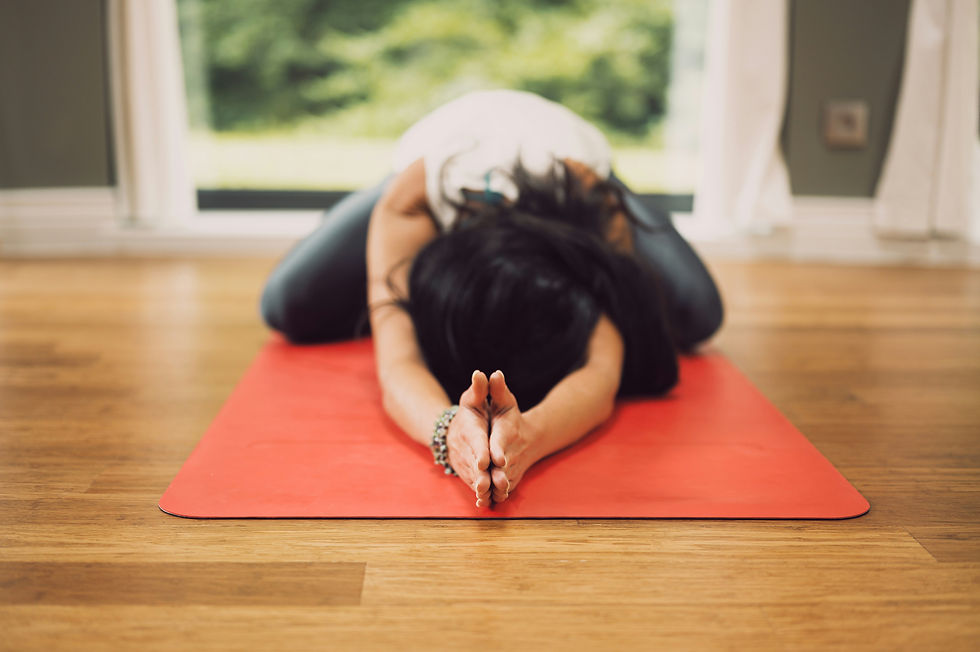
What Yin yoga is doing that other classes aren't
Most yoga classes are working with your muscles. Vinyasa, Yoga Strength, even a vigorous Jivamukti class- these styles engage and strengthen the muscular system. That's valuable.
But it's not what Yin is doing.
Yin yoga targets the deeper layers of the body. Fascia, connective tissue, ligaments, joints. These tissues are less elastic than muscle. They respond to sustained, still pressure held over time, typically three to five minutes per pose, rather than to movement and flow.
When you hold a Yin pose, you're gently pulling on the ligaments and connective tissue around a joint. Over time, this creates more space, more range of motion, and healthier, more resilient joints.
It's a slow process and a quiet one. But the cumulative effect is significant.
Why cold muscles are actually what you want
Here's the counterintuitive part that most people don't know.
When your muscles are warm and active, they absorb most of the load in any given stretch. Which means in a warm-body Yin practice, a lot of the work ends up in the muscles rather than reaching the deeper connective tissue you're actually trying to work on.
When your muscles are cool, as they are first thing in the morning, before the movements of the day have warmed and lengthened them, the muscles naturally sit in a shorter, more relaxed position. In that state, when you settle into a Yin pose, the deeper tissues take on more of the work. The fascia, the ligaments, the joints get properly loaded in a way that happens less efficiently later in the day.
This is why morning Yin is, on a purely physiological level, the most effective time to practice. Your muscles aren't in the way. The body is primed for exactly the kind of work Yin asks of it.
What it feels like to do morning Yin Yoga
It's not comfortable in the way a warm evening stretch feels comfortable. The body is stiffer. The first few minutes of a pose can feel intense.
But the release that comes, when the fascia begins to yield, when the nervous system settles into the stillness, when you move through the long holds and arrive at Savasana, is different from what happens in an evening class.
There's a quality of opening that stays with you through the whole day. Not just in the body. In the mind too.
Morning Yin has a way of clearing something that accumulated overnight. The connective tissue tightens slightly during sleep. A 60-minute morning practice works through that stiffness at the source, and most people find they move with more ease, more spaciousness, for the rest of the day.
When evening Yin makes sense
None of this means evening Yin isn't valuable. It's a different experience serving a different purpose.
An evening Yin class works with the nervous system in a specific way. The long, quiet holds encourage a shift from the sympathetic state, the active, alert mode the body runs on through the day, toward the parasympathetic state. Rest. Digest. Recover. If your goal is stress relief, unwinding, or better sleep, an evening class is a good match.
The choice often comes down to what you need.
Morning for mobility, range of motion, and a grounded start to the day.
Evening for unwinding and nervous system reset.
Both are right. They're just doing different things.
Yin yoga at Living Yoga in Parkwood, Johannesburg
Living Yoga runs two Yin yoga classes each week, taught by Baiju. She brings a depth of specialisation to Yin that's hard to find: a 500hr ISHTA certification plus dedicated training in Myofascial Yin, Chinese Medicine and Meridian Yin, and Yoga Nidra. Her classes are quiet, carefully sequenced, and built to be felt rather than performed. Read more about Baiju here.
Thursday mornings: 6:30 to 7:30 am, in-studio in Parkwood.
Friday evenings: 17:00 to 18:00, in-studio in Parkwood.
Both classes suit all levels. You don't need prior yoga experience to join a Yin class. The work is internal, not athletic, and the teacher helps you find the right depth for your body that day.
Living Yoga is at 13 Chester Rd, Parkwood, Johannesburg.
Drop-in: R220.
Book via the app or at livingyoga.co.za.
Not ready to commit to a schedule? The Living Yoga Library gives you access to every class we run, on your own time. Available at R350/month with no contract.


